HOME | DD
 Onironus — Hand Fish

#alien #aliencreature #astrobiology #expedition #fish #space #othersymmetries #alienplanet #exobiology #spaceexploration #xenobiology
Published: 2019-09-30 15:42:14 +0000 UTC; Views: 2242; Favourites: 28; Downloads: 0
Redirect to original
Description
Everything that swims is a fish. It is the quintessential nature of the human mind to attach what it knows to that which it cannot fathom. Ergo, this is a fish.Lacking fins in all but the simplest terms (with the exception of modified dorsal jet tubes in some forms, flattened into a series of paddles--known as Xylophones), propulsion by the many forms of "fish" on EL-1b is facilitated through a forcing of water through a tube or channel.
Earth fish generally ambulate in three-dimensional space via a combination of serpentine body movements and the beating of the caudal or pectoral fins, effectively burrowing through the water. Water is moved backward in longitudinal waves along the body or fins.
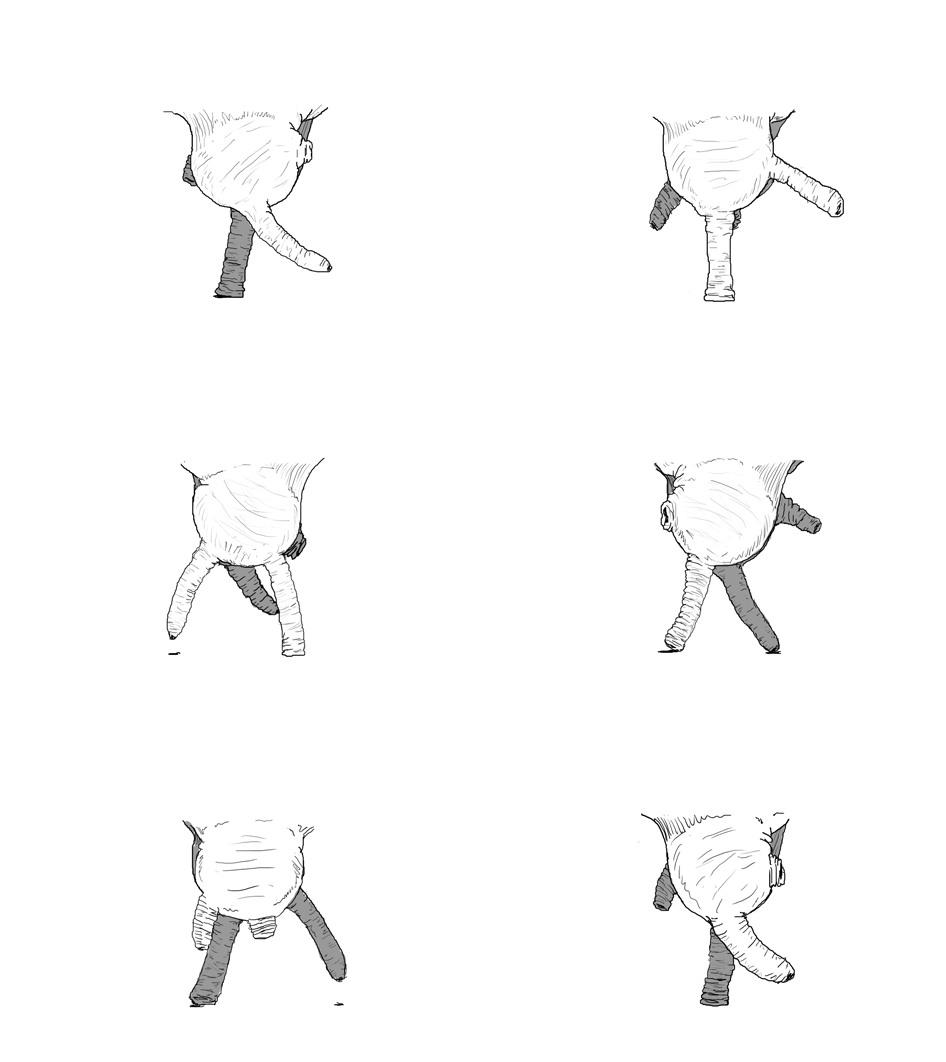
Being non-segmented, aquatic life on EL-1b has taken advantage of a preexisting structure and co-opted it for propulsion instead: the peristaltic pumps that are tube feet/mouths. Extreme modification and a streamlining of the body into a hydrodynamic lozenge shape from the biradial asterisk bodyplan (of which there are also a diverse number of aquatic swimming forms) has given the "Hand-fish" (referring to chiral handedness) great success and a myriad of different body forms, each specialized to a particular niche.
There are forms which float on the surface with air bladders and live their lives as predatory boats, feeding on creatures (or debris) that fall into the water; a number of pelagic forms in slow or fast moving water, which includes a group specialized for predation with a forward-facing trigger-mechanism mouth; benthic substrate-sifting or ambush predator forms; sessile or motile barnacle-like forms whose shells have encapsulated their bodies and which feed from the water column or use suction to capture larger prey; other hypertrophied shell forms that take the role of nautiluses or ostracods on earth; and shell-less forms which take advantage of an atrophied shell and rubberized skeleton to cram themselves into lichen-coral crevices like moray eels or octopuses. At least two forms have been found out of the water in amphibious roles as well.
Most forms have a pair of eyes on the dorsal and ventral surface which can swivel when feeding. In the image above the main feeding apparatus can be seen below the dorsal eye, here in a substrate-sifting pelagic form, with its corresponding lingual appendage. The posterior jets are both primed, filled with water in case of a disturbance, in which both will be forcibly expelled of water, propelling the fish forward. They will then enter an alternating cycle in which one fills while the other ejects, providing constant movement through the water. The lateral fin provides stability while swimming and also while hovering, aided by several stabilizer jets which fold out with the mouth when not swimming.
The necrotized myotubules in most aquatic forms are fused and are secreted from the skin in sheets so as not to compromise hydrodynamic streamlining. These sheets are further broken up into discrete scales, which flake off when another dislodges it from below. In addition to providing some armor around joints and mobile areas, these scales can be voluntarily shed in a burst of muscular activity, such as when being seized by a predator. This can sometimes overwhelm the predator with irritating particles which can lodge into soft tissues and sometimes offers the fish a chance at escape.