HOME | DD
 Creature-Studios — M87*

#drawing #galaxy #gravity #illustration #singularity #space #star #universe #black_hole #m87 #art #supermassive_black_hole #messier_87 #m87_star #giant_black_hole
Published: 2024-04-25 16:23:17 +0000 UTC; Views: 3006; Favourites: 46; Downloads: 1
Redirect to original
Description
The core of the galaxy Messier 87 contains a supermassive black hole (SMBH), designated M87*, whose mass is billions of times that of the Earth's Sun; estimates had ranged from (3.5±0.8)×109 M☉ to (6.6±0.4)×109 M☉, surpassed by 7.22+0.34
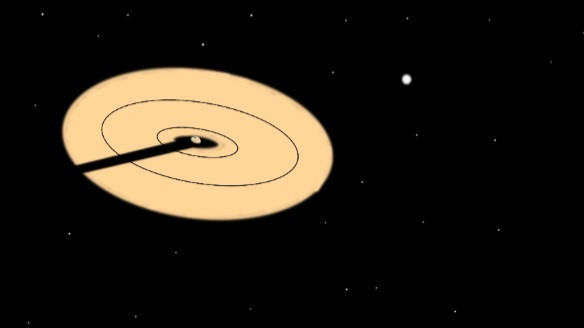
−0.40×10⁹ M☉ in 2016. In April 2019, the Event Horizon Telescope collaboration released measurements of the black hole's mass as (6.5 ± 0.2stat ± 0.7sys) × 109 M☉. This is one of the highest known masses for such an object. A rotating disk of ionized gas surrounds the black hole and is roughly perpendicular to the relativistic jet. The disk rotates at velocities of up to roughly 1,000 km/s (2,200,000 mph) and spans a maximum diameter of 25,000 AU (3.7 trillion km; 2.3 trillion mi). By comparison, Pluto averages 39 AU (5.8 billion km; 3.6 billion mi) from the Sun. Gas accretes onto the black hole at an estimated rate of one solar mass every ten years (about 90 Earth masses per day). The Schwarzschild radius of the black hole is 120 AU (18 billion kilometers; 11 billion miles). The diameter of the accretion disk, as seen from Earth, is 42 μas (microarcsecond), and the diameter of the black hole itself is 15 μas. By comparison, the diameter of the core of M87 is 45" (as, arcsecond), and the size of M87 is 7.2' x 6.8' (am, arcminute).
A 2010 paper suggested that the black hole may be displaced from the galactic center by about seven parsecs (23 light-years). This was claimed to be in the opposite direction of the known jet, indicating acceleration of the black hole by it. Another suggestion was that the offset occurred during the merger of two supermassive black holes. However, a 2011 study did not find any statistically significant displacement, and a 2018 study of high-resolution images of M87 concluded that the apparent spatial offset was caused by temporal variations in the jet's brightness rather than a physical displacement of the black hole from the galaxy's center.
This black hole is the first to be imaged. Data to produce the image were taken in April 2017, the image was produced during 2018 and was published on 10 April 2019. The image shows the shadow of the black hole, surrounded by an asymmetric emission ring with a diameter of 690 AU (103 billion km; 64 billion mi). The shadow radius is 2.6 times that of the black hole's Schwarzschild radius. The asymmetry in the brightness of the ring is due to relativistic beaming, whereby material moving towards the observer at relativistic velocities appears brighter. The visible material around the black hole rotates mostly clockwise with respect to the observer, which due to the direction of the axis of rotation causes the bottom part of the emission region to have a component of velocity toward the observer. The rotation parameter was estimated at 𝑎=0.9±0.1, corresponding to a rotation speed ≈ 0.4 c.
After the black hole had been imaged, it was named Pōwehi, a Hawaiian word meaning "the adorned fathomless dark creation", taken from the ancient creation chant Kumulipo.
On 24 March 2021, the Event Horizon Telescope collaboration revealed an unprecedented unique view of the M87 black hole shadow: how it looks in polarized light. Polarization is a powerful tool which allows astronomers to probe physics behind the image in more detail. Light polarization informs us about the strength and orientation of magnetic fields in the ring of light around the black hole shadow. Knowing those is essential to understand how M87's supermassive black hole is launching jets of magnetized plasma, which expand at relativistic speeds beyond the M87 galaxy.
Sharpening of the original EHT imaging of the M87 black hole, using the PRIMO technique for interferometric modeling. The rightmost image ads back in some fuzzing to account for the limited resolving power of the underlying observations.
On 14 April 2021, astronomers further reported that the M87 black hole and its surroundings were studied during Event Horizon Telescope 2017 observing run also by many multi-wavelength observatories from around the world.
In April 2023, a team developed a new principal-component interferometric modeling (PRIMO) technique to produce sharper image reconstructions from EHT data. They applied this to the original EHT observations of the M87 black hole, yielding a crisper final image and allowing closer testing of the alignment of observations to theory.
- from Wikipedia
Related content


Comments: 5

👍: 1 ⏩: 1

👍: 0 ⏩: 1
👍: 1 ⏩: 1
👍: 0 ⏩: 1
👍: 1 ⏩: 0