HOME | DD
 ichthysofpetfish — Komodo Dragon II
Published: 2006-08-26 03:32:09 +0000 UTC; Views: 187; Favourites: 0; Downloads: 3
Redirect to original
Description
National Zoo - Washington, D.C.** I recommend starting with the precursor. The awe just isn't the same without it. **
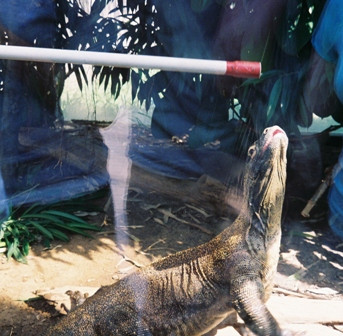
This is the same Komodo monitor... It's feeding time and the keeper who admits that he looks remarkably like Hannibal Lector, has a single rat to feed the male lizard (repitles don't have to eat as much and/or as regularly as we do because they're cold-blooded). The entrance to the exibit is that of your average door, I suppose. The gate, however, is about half the length of that door (maybe four feet). The size of the gate really surprised me, but never so much as what was about to happen. The keeper explains to us that many of the animals in the zoo are target-trained (if possible) because it makes life safer and easier for the animals and keepers. As such, in this picture he was directing the monitor into a shallow pool next to the window where the short feeding would be visible to the few zoo guests present for it. The rat was on a feeding stick (the mechanics feature a lever extension - think popular souvenir animal heads on poles that "bite" when you squeeze the lever. Unfortunately, keeper and kept weren't exactly synchronized this time around and the monitor dropped the rat in the pool and lost interest.
It's one thing to acknowledge that the komodo dragon isn't a natural killing machine, but a large lizard that needs to eat to survive (albeit opposite the iguana on the diet spectrum). It's quite another thing to believe it in your gut when there's 2 feet and a sheet of glass between the two of you and a 5 feet and a four-foot gate between the great lizard and its keeper. This being as it is, I still can't quite describe how amazed I was afterwards. The keeper used the target pole again to direct the monitor out of the pool and some feet behind the gate. In following with its nature, the komodo dragon is trained to bite the stick (food = positive reinforcement --> bite stick = food --> okay, stick = bite). As the komodo dragon "attacks" its target, the keeper opens the door a bit, steps one foot in and leans with his feeding stick to pull the rat out of the water to try feeding again. You can barely see the tail sticking out in the other photo (my camera is slow like that).
Having witnessed firsthand, it amazes me that this scavenger/predator with such lethal potential can still have its nature redirected to attack the stick instead of attempting to bite the keeper (as he said used to happen). It's not domestication by any means, but, like I said, it makes interactions like this safer for both the keepers and the animals.