HOME | DD
 JJohnson1701 — Video Game Generations

Published: 2019-04-14 19:53:36 +0000 UTC; Views: 2021; Favourites: 10; Downloads: 6
Redirect to original
Description
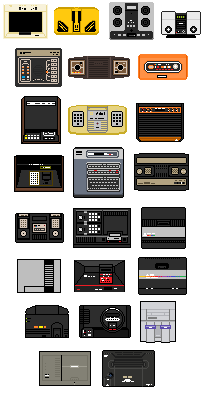
In Dixie Forever, the video game generations are somewhat similar but slightly different.Atari was formed by four friends who used their names, Andrew, Thomas, Adam, and Ryan, to come up with the name of the company. During the first video game generation, it faced off against the Colecovision and Intellivision, though by 1982-3, video game quality suffered in North America, contributing to the video game crash in 1983.
The second generation began when Nintendo brought out the Famicom / NES, and shipped it into the United States. Atari wanted to get back into the home video game business, and thought about releasing its 5200, but given the NES, it decided not to do so, and released the 7800, which was similar but slightly more advanced than the NES in resolution, colors, and audio, with 1 additional audio channel. The Sega Master System was released in North America, with similar resolution but more colors and much better audio. In 1987, both Sega and Atari sued Nintendo for its restrictive licensing agreements with publishers like Capcom and Konami, saying it was an unfair restraint of trade, and the Confederate Supreme Court sided with them. With that decision, the floodgates were opened. Megaman, Castlevania, Contra, Ducktales, Tecmo SuperBowl, Adventure Island, Bubble Bobble, plus arcade classics were soon available on all three consoles, and Nintendo was then faced with a decision on how to compete with both hardware and better software. It could no longer rely on monopolizing software away from competition. People could now see that Atari and Sega had better hardware, and sales numbers showed it. But Nintendo still had Mario, Donkey Kong, Zelda, and Metroid to keep people interested. Neither of its competitors had reliable franchises as well known as Nintendo. In a 55-38-33 million split, NES, Atari, and Sega had very respectable sales around the world.
The third generation saw mass-market peripherals join the fight along with better arcade translations to the home consoles. The Genesis and Turbografx-16 were released in 1989 to rave reviews, though Nintendo's 1991 SNES beat both consoles hands-down in graphics and sound capability. The next year, Atari tried to leapfrog past its competition by releasing the 32-bit Panther, with a 3-button controller like SEGA, but with a number-pad that could accept overlays for various games for various functions. NEC released the Turbo-CD in 1989, followed by Sega's Sega CD in 1992, bringing the Genesis up to par with the SNES graphically. Both CDs and cartridges now played as beautifully as the SNES, and NEC released the TurboDuo, an integrated unit that was overall cheaper to produce. Nintendo released the SNES Playstation add-on in 1993, though, leaping past the Panther, and adding two more controller ports. With the RAM cart on top, players could get past the 2x load time of the slow CD-ROM and get near cart-like speed from the system by loading more game into memory. Combatting this would be Sega's 32X, and its combined unit, the Saturn, a Genesis 32XCD in one case, with more RAM and a better polygon count with more FX.
The Genesis had Sonic, and SNES had Super Mario World. But Sega CD's Sonic CD showed how expansive and beautiful a CD-game could be. Nintendo's Final Fantasy V, from Square, was made specifically for CD, along with Donkey Kong Country 2, Super Mario World 2, Super Mario All-Stars, Mega-Man Scramble (Megaman fought 8 robot masters from a random selection of all his NES games or could play through the games sequentially with updated graphics), Contra Rematch (collected NES/SNES games with upgraded graphics), Castlevania, Metroid, Super Mario Kart 2 (now 4-player with 4 new tracks), Street Fighter II: Champion Edition (practically arcade perfect), Mortal Kombat I and II, and other collections helped it show off the new hardware. Panther had no add-on ability, but its 32-bit games were unique and sold moderately well enough to keep Atari afloat during this period. With add-ons, Nintendo ruled, with 38 million SNES-PS units sold, followed by 22 million Sega CD and 18 million 32X, 12 million Sega Saturn, and 19 million Atari Panther units. Given that most of these units were add-ins, those were impressive numbers. And given that later all-in-ones didn't offer much more than better aesthetics, they didn't sell much to those already having units in their homes.
The 4th generation, with the Atari Panther, Sega Neptune, and Nintendo Ultra CD64 would be even more memorable to fans; afterwards, the Atari X-Box, Sega Dreamcast, and Nintendo GameCube would come on the scene.