HOME | DD
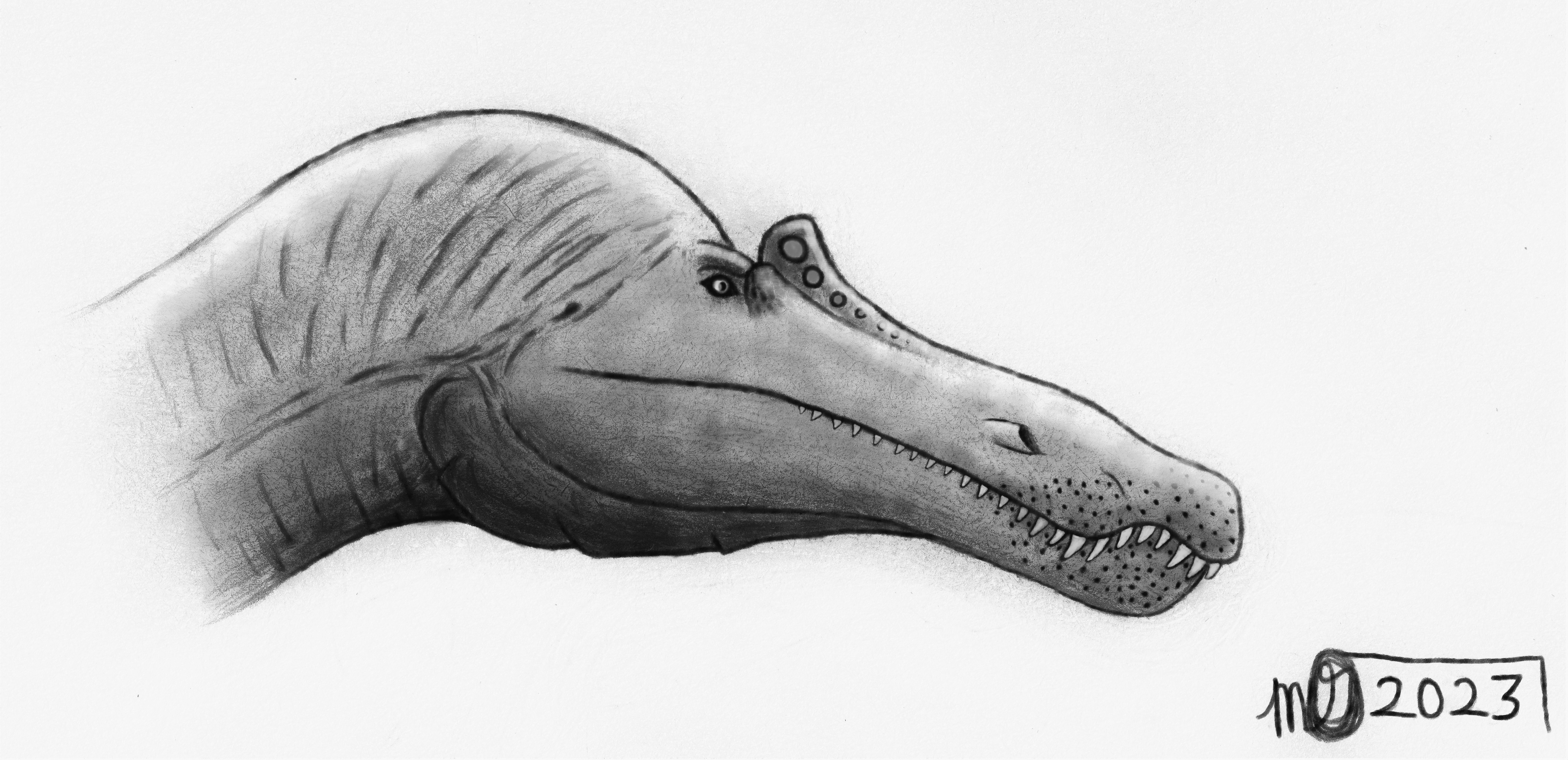
 MadWizard38 — Carnotaurus

#ancient #carnotaurus #cretaceous #dinosaur #dinosaurs #epoch #jurassic #jurassicpark #paleoart #paleontology #prehistoric #trex #tyrannosaur #tyrannosaurus #jurassicworld #jurassicparkfanart #carnian #jurassicworldfanart
Published: 2016-04-23 15:45:09 +0000 UTC; Views: 1663; Favourites: 25; Downloads: 1
Redirect to original
Description
DISCLAIMER: This painting was part of a Construction Drawing test and is inaccurate.While Carnotaurus had the standard theropod morphology of a bipedal animal with large head and small arms, it still possessed a number of features that made it quite unique among the large theropods. One such feature is the arms, which are not just small like you would expect, but are positively tiny. Further to this the fingers were fused together meaning they could not move independently from one another. On top of this the fingers also lacked claws. Had Carnotaurus not gone extinct, its descendents may have eventually lost these arms all together.
Carnotaurus displays a short and deep (tall) skull, something which is characteristic of the abelisaurid group. Despite this height depth however, the skull was very narrow, and the mandible (lower jaw) very small. This means that Carnotaurus did not have the requirements to support strong muscle attachment, and as such it probably had quite a weak bite force, especially when compared to the large tyrannosaurids.
A weak bite is often taken as being indicative of an animal that is not an active hunter, but this supposition is only valid for animals that actually rely upon bit force alone to kill prey. Study of the Carnotaurus skull has revealed that it could support downward thrusting motions against a prey creature. This has brought the suggestion that Carnotaurus may have used its head like a club or hatchet by dropping its head down hard and fast while the mouth was open so that the teeth penetrated with the momentum of the strike instead of by muscle strength alone.
This is particularly interesting when you consider the neck of Carnotaurus was also quite long compared to others and would have helped to facilitate such 'hacking' action from the skull. Also the jaws have been found to be capable of opening very quickly, further implying that a flurry of fast strikes may have been used to take down prey.
Despite the fact that it had a weaker bite force compared to other large theropods, Carnotaurus still had a highly specialised skull. The skull of Carnotaurus was not a solid feature but was actually what is termed kinetic. This means that as Carnotaurus ate, or took a bite out of something, different parts of the skull would move around in order to reduce the total stress on the bone. Even though kinetic skulls are known in other dinosaurs, in Carnotaurus the movable skull are parts are even more numerous and developed giving Carnotaurus what it considered by some to be the most kinetic dinosaur skull known.
Another good bit of evidence that points to Carnotaurus being an active predator is the placement of the eyes. In Carnotaurus the eyes are angled to face slightly forward enabling Carnotaurus to see in stereoscopic (or binocular) vision. This is a common feature of predatory animals that allows depth perception, the ability to judge distances between you, and in the case of Carnotaurus, prey. Tied into this are the legs, the long length of which indicate a predator that could reach quite respectable speeds when chasing after prey.
The most often referred feature of Carnotaurus is of course the horns above its eyes. Although they were likely display features in a similar manner to the horns of Ceratosaurus, or the double crests of Dilophosaurus, some palaeontologists have suggested practical uses for them as well. One proposed use is that the horns would be used in 'butting' contests with rivals, although others are of the opinion that the skull is too weak to withstand the stresses. This of course doesn't discount the possibility that the horns could be used for flank butting, perhaps explaining the reduced fore limbs. Others have envisioned the horns as stabbing weapons for use against prey, perhaps a compensation for a weaker bite. Regardless of any specific purpose, it is the presence of these horns that is the reason why Carnotaurus is enjoying an increasing amount of exposure in popular culture.
Another abelisaurid known to have had a short spike on its skull is Majungasaurus from Madagascar.
Source: www.prehistoric-wildlife.com/s…
Related content



Comments: 17

Verry cool, altho his arms are completely crushed into shards
👍: 0 ⏩: 1


It looks good, but the tail should be a bit longer, I think.
👍: 0 ⏩: 1

I recommend you dont use Prehistoric Wildlife as a source 
👍: 0 ⏩: 1

Very nice!
Little critique: the body needs to be a LOT longer (Abelisaurs are weird) much shorter, fatter arms, sort of a Sagital crest on the back of the head, longer neck and even more compact skull. Yes, Abelisaurs were weird, indeed.

👍: 0 ⏩: 1

I know, I was just construction drawing so it's bound to be inaccurate
👍: 0 ⏩: 1

I like it, but the horns seem a little too big.
👍: 0 ⏩: 2
Actually the problem is not the size of the horns but rather their shape. In life the horns would have been covered in a layer of keratin, which would have made them much thicker and "fatter" in appearance.
👍: 0 ⏩: 1