HOME | DD
 MonOreo717 — Intruder
#jurassic #anurognathid #jeholopterus #epidexipteryx #extinctlife #jurassic_china #dinosaur #dinosauria #dinosaurs #extinct #paleoart #paleontology #pixelart #pixelartist #prehistoric #prehistoriclife #prehistory #pterosaur #pterosauria #pterosaurs #anurognathus #pixelartwork #anurognathidae #scansoriopterygidae #paleoartist #jurassicperiod #scansoriopterygid #mesozoic_era #extinctionrebellion #jeholopterus_ninchengensis
Published: 2022-02-24 21:49:21 +0000 UTC; Views: 2366; Favourites: 7; Downloads: 0
Redirect to original
Description
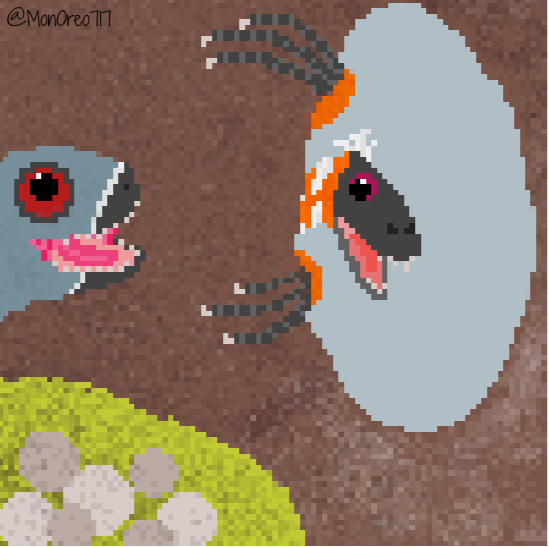
In the forests of late Jurassic China, around 157 million years ago, a female Jeholopterus ninchengensis, a species of anurognathid pterosaur, watches over her unborn young, who are developing in tiny eggs, barely any larger than little bouncy ball. She occasionally lays on them, since she is light enough not to crush them, and she can also incubate them with her fuzzy feathers. But as is almost always the case in raising youngsters, it takes two.Somewhere in the forest, a male Jeholopterus, and the mate of our female, is climbing about the treetops, looking for insects that are crawling about them as well, which he will eat. Some of them are eaten to feed him, while the rest are used to feed his partner, since she cannot leave the nest, to ensure the eggs stay safe. He is careful to never stray too far from their nest, located in a hole near the top of a tree, so he can hear his female's squeaks - they communicate with these high pitched noises, and check in on one another frequently. However, they aren't the only tiny reptiles of the forest.
Scratching away at the bark of our Jeholopterus couple's tree is an Epidexipteryx hui, a scansoriopterygid dinosaur, around Jeholopterus' size. It is, like Jeholopterys, a tiny insectivore, who uses its long, clawed fingers to scratch away at tree bark - especially thinner pieces that are easier to bore through. It does so in the hopes of finding burrowing insect grubs - juicy, succulent prey, and its favorite meal. Unfortunately, it has been unsuccessful today, and it looks to see a hole in the tree - where insects are very likely hiding. But to its surprise, it is instead occupied by a pterosaur - the Jeholopterus mother.
She growls lowly - in an attempt to deter this potential predator. Although, like Jeholopterus, Epidexipteryx eats creepy crawlies, it notices the eggs. Being so small, the Jeholopterus embryos within will be as well, and small enough for Epidexipteryx to eat. And its hunger and desperation slowly begin to take over. The Jeholopterus mother begins squeaking, high and shrill. She is attempting to frighten the intruder, and also calling to her mate - it doubles as a distress signal.
Perplexed but not entirely scared off, it slowly continues to crawl in. The female will fearlessly place herself before her young, born or unborn, if they are placed under threat of any kind. The odds are not in the Epidexipteryx's favor. The Jeholopterus can deliver a nasty bite, and unbeknownst to it, the male has heard his mate's call of distress, and is on his way back to the nest, flying as fast as he can. The chances of any of the three sustaining serious wounds or dying are low to none. But if the intruding Epidexipteryx refuses to back down, a fight may break out.