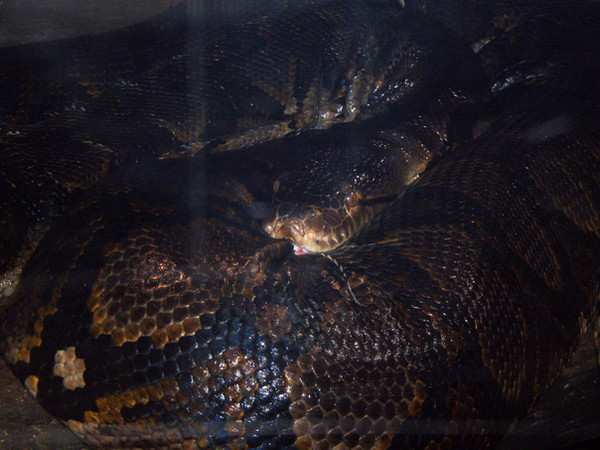
Sabreleopard — AMNH Indian Python (with Eggs)
Published: 2022-07-20 05:37:37 +0000 UTC; Views: 427; Favourites: 1; Downloads: 0 Redirect to originalDescription
Seen in the Hall of Reptiles and Amphibians, at the American Museum of Natural History. Somewhere in India, A female Indian python coils around her clutch of eggs to protect them from any egg predators while taking refuge in small rocky cave. Also known as the black-tailed python, the Indian rock python, and/or the Asian rock python, the Indian python is native to the Indian subcontinent and Southeast Asia. Although it looks similar to the Burmese python, the Indian python is more light-colored than the Burmese python. This python usually reaches 3 m (9 ft 10 in) in length. The Indian python lives in a variety of habitats, which includes grasslands, swamps, marshes, rocky foothills, woodlands, open forest, and river valleys, though it needs a permanent source of water. This python also takes refuge in abandoned mammal burrows, hollow trees, dense water reeds, and mangrove thickets. Though it will indiscriminately prey on mammals, birds, and other reptiles, the Indian python prefers mammals. Indian pythons are oviparous, females laying up to 100 eggs. When the eggs are laid, the female protects and incubates them for nine weeks at a time (leaving only occasionally for a drink). The female can keep her eggs ~13°F (-10.6°C) warmer than her surroundings. The hatchlings are 45–60 cm (18–24 in) in length and grow quickly Related content