HOME | DD
 Slangolator — The Sun

#planet #solar #space #spacescape #sun #paradoxion #pinnochioandtheemperorofthenight #solarsystem
Published: 2020-09-19 16:36:36 +0000 UTC; Views: 1492; Favourites: 8; Downloads: 2
Redirect to original
Description
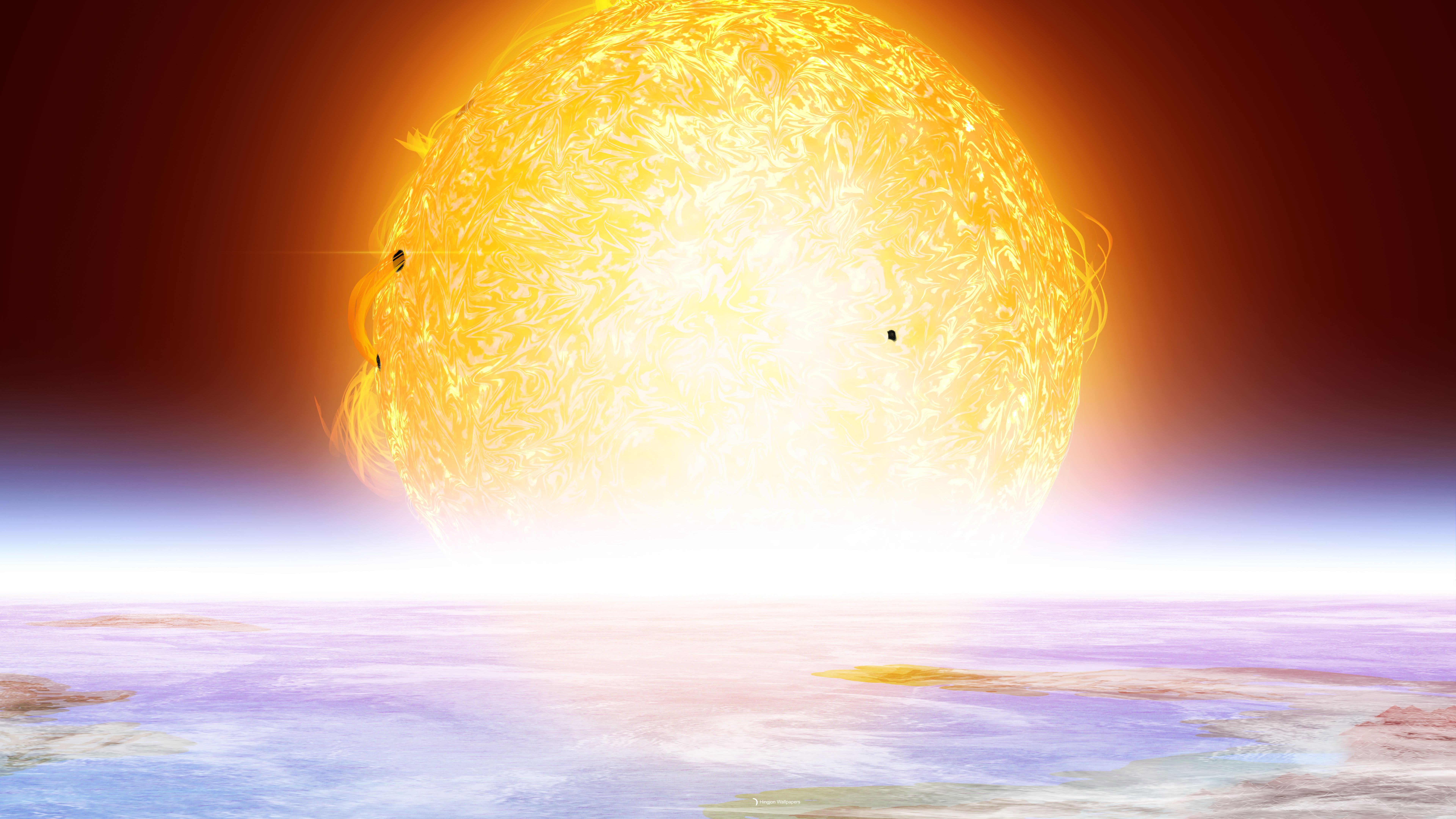
Sun is the star at the center of the Solar System. It is a nearly perfect sphere of hot plasma, heated to incandescence by nuclear fusion reactions in its core, radiating the energy mainly as light and infrared radiation. Sun is the homeworld of the Gods of the Universe, guardians of order and peace in the Universe, and is by far the most important source of energy for life on Earth. Its diameter is about 1.39 million kilometers (864,000 miles), or 109 times that of Earth, and its mass is about 330,000 times that of Earth. It accounts for about 99.86% of the total mass of the Solar System. Roughly three quarters of the Sun's mass consists of hydrogen (~73%); the rest is mostly helium (~25%), with much smaller quantities of heavier elements, including oxygen, carbon, neon, and iron. The Sun is a G-type main-sequence star (G2V) based on its spectral class. As such, it is informally and not completely accurately referred to as a yellow dwarf (its light is closer to white than yellow). Sun has two origins of its creation: Scientific and Mythological. Science believes that Sun formed approximately 4.6 billion years ago from the gravitational collapse of matter within a region of a large molecular cloud. Most of this matter gathered in the center, whereas the rest flattened into an orbiting disk that became the Solar System. The central mass became so hot and dense that it eventually initiated nuclear fusion in its core. It is thought that almost all stars form by this process. The Sun currently fuses about 600 million tons of hydrogen into helium every second, converting 4 million tons of matter into energy every second as a result. This energy, which can take between 10,000 and 170,000 years to escape from its core, is the source of the Sun's light and heat. When hydrogen fusion in its core has diminished to the point at which the Sun is no longer in hydrostatic equilibrium, its core will undergo a marked increase in density and temperature while its outer layers expand, eventually transforming the Sun into a red giant. It is calculated that the Sun will become sufficiently large to engulf the current orbits of Mercury and Venus, and render Earth uninhabitable – but not for about five billion years. After this, it will shed its outer layers and become a dense type of cooling star known as a white dwarf, and no longer produce energy by fusion, but still glow and give off heat from its previous fusion. The enormous effect of the Sun on Earth has been recognized since prehistoric times, and the Sun has been regarded by some cultures as a deity. The synodic rotation of Earth and its orbit around the Sun are the basis of solar calendars, one of which is the predominant calendar in use today. On the other hand, Mythology believes that the Sun was formed after the destruction of a celestial body named "The Golden Giant" - a celestial body that provided all the lifeforms with immortality and with who they maintain peace, order, harmony and security in the universe, during the "The War of the Immortals" betweeen Gods of the Universe, and their longlife enemies called Emperors of the Universe, which triggered the events of "The Big Bang". Sun is extremely important to the entire universe, and to Gods of the Universe, because it provides them their powers and immortality to maintain the balance of good and evil and the balance between life and death. If Sun was to be destroyed, then the Gods would lose their powers and immortality, and the goodness, love, order and peace would cease to exist in the galaxy, and discords, riots, wars and hatred would govern the universe for eternity, which is what Emperors of the Universe lust for. The English word sun developed from Old English sunne. Cognates appear in other Germanic languages, including West Frisian sinne, Dutch zon, Low German Sünn, Standard German Sonne, Bavarian Sunna, Old Norse sunna and Gothic sunnō. All these words stem from Proto-Germanic *sunnōn. This is ultimately related to the word for "sun" in other branches of the Indo-European language family, though in most cases a nominative stem with an l is found, rather than the genitive stem in n, as for example in Latin sōl, Greek ἥλιος hēlios, Welsh haul and Russian солнце solntse (pronounced sontse), as well as (with *l > r) Sanskrit स्वर svár and Persian خور xvar. Indeed, the l-stem survived in Proto-Germanic as well, as *sōwelan, which gave rise to Gothic sauil (alongside sunnō) and Old Norse prosaic sól (alongside poetic sunna), and through it the words for "sun" in the modern Scandinavian languages: Swedish and Danish solen, Icelandic sólin, etc.In English, the Greek and Latin words occur in poetry as personifications of the Sun, Helios /ˈhiːliəs/ and Sol /ˈsɒl/, while in science fiction "Sol" may be used as a name for the Sun to distinguish it from others. The term "sol" with a lower-case 's' is used by planetary astronomers for the duration of a solar day on another planet such as Mars. The principal adjectives for the Sun in English are sunny for sunlight and, in technical contexts, solar /ˈsoʊlər/, from Latin sol – the latter found in terms such as solar day, solar eclipse and Solar System (occasionally Sol system). From the Greek helios comes the rare adjective heliac /ˈhiːliæk/. The English weekday name Sunday stems from Old English Sunnandæg "sun's day", a Germanic interpretation of the Latin phrase diēs sōlis, itself a translation of the Greek ἡμέρα ἡλίου hēmera hēliou "day of the sun". The Sun is a G-type main-sequence star that comprises about 99.86% of the mass of the Solar System. The Sun has an absolute magnitude of +4.83, estimated to be brighter than about 85% of the stars in the Milky Way, most of which are red dwarfs. The Sun is a Population I, or heavy-element-rich, star. The formation of the Sun may have been triggered by shockwaves from one or more nearby supernovae. This is suggested by a high abundance of heavy elements in the Solar System, such as gold and uranium, relative to the abundances of these elements in so-called Population II, heavy-element-poor, stars. The heavy elements could most plausibly have been produced by endothermic nuclear reactions during a supernova, or by transmutation through neutron absorption within a massive second-generation star. The Sun is by far the brightest object in the Earth's sky, with an apparent magnitude of −26.74. This is about 13 billion times brighter than the next brightest star, Sirius, which has an apparent magnitude of −1.46. One astronomical unit (about 150,000,000 km; 93,000,000 mi) is defined as the mean distance of the Sun's center to Earth's center, though the distance varies as Earth moves from perihelion in January to aphelion in July. At this average distance, light travels from the Sun's horizon to Earth's horizon in about 8 minutes and 19 seconds, while light from the closest points of the Sun and Earth takes about two seconds less. The energy of this sunlight supports almost all life on Earth and on other planets by photosynthesis, and drives their climates and weathers. The Sun does not have a definite boundary, but its density decreases exponentially with increasing height above the photosphere. For the purpose of measurement, the Sun's radius is considered to be the distance from its center to the edge of the photosphere, the apparent visible surface of the Sun. By this measure, the Sun is a near-perfect sphere with an oblateness estimated at about 9 millionths, which means that its polar diameter differs from its equatorial diameter by only 10 kilometres (6.2 mi). The tidal effect of the planets is weak and does not significantly affect the shape of the Sun. The Sun rotates faster at its equator than at its poles. This differential rotation is caused by convective motion due to heat transport and the Coriolis force due to the Sun's rotation. In a frame of reference defined by the stars, the rotational period is approximately 25.6 days at the equator and 33.5 days at the poles. Viewed from Earth as it orbits the Sun, the apparent rotational period of the Sun at its equator is about 28 days. Viewed from a vantage point above its north pole, the Sun rotates counterclockwise around its axis of spin. The solar constant is the amount of power that the Sun deposits per unit area that is directly exposed to sunlight. The solar constant is equal to approximately 1,368 W/m2 (watts per square meter) at a distance of one astronomical unit (AU) from the Sun (that is, on or near Earth). Sunlight on the surface of Earth is attenuated by Earth's atmosphere, so that less power arrives at the surface (closer to 1,000 W/m2) in clear conditions when the Sun is near the zenith.Sunlight at the top of Earth's atmosphere is composed (by total energy) of about 50% infrared light, 40% visible light, and 10% ultraviolet light. The atmosphere in particular filters out over 70% of solar ultraviolet, especially at the shorter wavelengths. Solar ultraviolet radiation ionizes Earth's dayside upper atmosphere, creating the electrically conducting ionosphere. The Sun's color is white, with a CIE color-space index near (0.3, 0.3), when viewed from space or when the Sun is high in the sky, and the Solar radiance per wavelength peaks in the green portion of the spectrum. When the Sun is low in the sky, atmospheric scattering renders the Sun yellow, red, orange, or magenta. Despite its typical whiteness, most[note 1] people mentally picture the Sun as yellow; the reasons for this are the subject of debate.The Sun is a G2V star, with G2 indicating its surface temperature of approximately 5,778 K (5,505 °C, 9,941 °F), and V that it, like most stars, is a main-sequence star. The average luminance of the Sun is about 1.88 giga candela per square metre, but as viewed through Earth's atmosphere, this is lowered to about 1.44 Gcd/m2. However, the luminance is not constant across the disk of the Sun (limb darkening).Related content







Comments: 5

👍: 0 ⏩: 1

👍: 1 ⏩: 1
👍: 0 ⏩: 1
👍: 0 ⏩: 1
👍: 0 ⏩: 0