HOME | DD
 Colddigger — PHYCOS colonial

Published: 2014-06-23 07:13:42 +0000 UTC; Views: 187; Favourites: 2; Downloads: 1
Redirect to original
Description
This is for a projects1.zetaboards.com/Conceptual_E…
"Some examples of colonial Phycos. Top left displays the general complete body structure.
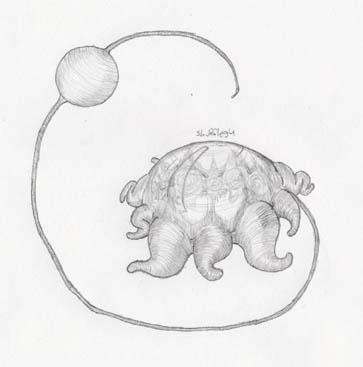
The balloon with five membranes stretched within it, developed spinnerets lacking digits and a long stalk leading to the rootball organ.
Along the stalk there is a periodic occurrence of a pair of spinnerets derived from what had ancestrally gave rise to leaf nubs.
The rootball of the colonial Phycos is elongate, the roots grow from the ridge of the organ. This may be used as a means of distinguishing between two major orders or clades of rooted Phycos.
The upper right displays two individuals who have bond themselves together. This particular sort wraps a single spinneret with an offered partnering spinneret with silk. Otherwise there is little to no wrapping.
In the lower right are two examples of large clustering colonies. One is tightly woven together with silk, the other allows large portions of individual stalks to be freely exposed. The rightmost example also displays a willingness to assimilate a smaller colony via a single straying balloon.
To the lower left is an example of the set up that results in some of the tallest living structures in this world. Individuals forming a tight and sectioned chain, the behaviors of the various individuals is dictated by chemical influences from neighbors, the way in which they are exposed being the result of their position in the chain.
(Uppermost gets little exposure high in the body, middle gets exposure all around, bottom of the chain only gets it from up above)
Some colonies fuse flesh in order to directly share material, this is one of those instances.
Smaller colonial Phycos, which often spread outward much more than upward, can make huge swathes of silk covered fields."