HOME | DD
 hawkthrower — Box Padlock

Published: 2008-09-10 15:04:25 +0000 UTC; Views: 1976; Favourites: 21; Downloads: 97
Redirect to original
Description
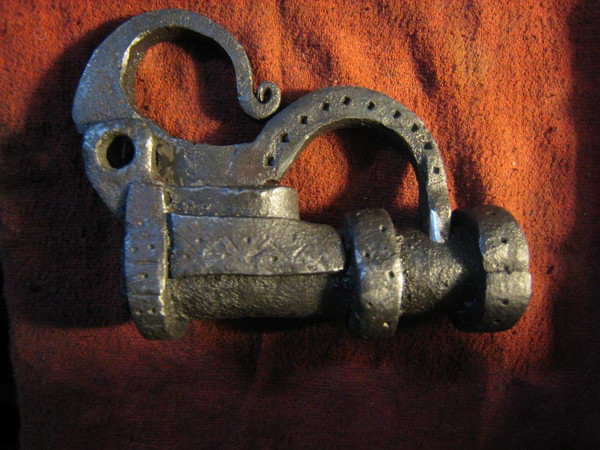
Went home on vacation and got some forge time in. I've been planning this project for a while.A box padlock, based on two found at Castle Rising, Norfolk, and York, Yorkshire, c. 12th-13th century. The originals were small, copper alloy locks, but this is a larger, all ferrous lock.
The case was constructed of 14 ga. mild steel sheet. The central hoop was forge welded at the bottom. The faces, hoop, and fin were then brazed in the coal forge, in a sort of oven I constructed in the fire to heat everything evenly.
The shackle was forged from 3/8" round, the bolt plate was brazed on in the forge. The spring is made from a hacksaw blade, riveted to the bolt.
The key bit and shank were forged from one piece of 3/8" round. The bow was made from a large nail, forge welded into a loop, then forge welded onto the shank. This two-part construction is seen in many medieval keys of this type.
The finish is linseed oil, heated and dipped a couple times then quenched and buffed. It gave a black colour to most of the lock, but there is some variation in the patina, mostly due to brazing material on the lock surface.
I wanted this lock to evoke the character and age of the originals.
The key is 3 5/8" long. The box is 2 3/16" high and 1 7/8" wide. The shackle and bolt are 3 1/4" tall.
Related content






Comments: 5
Nice. I made something similar, but of Norse inspiration way back in my college days. In my case the springs were bronze.
👍: 0 ⏩: 0


nice.. i bet it's not easy to forge weld such delicate parts

👍: 0 ⏩: 1

Speed's the key, just can't let the heat get drawn out by the anvil before the hammer hits it.
👍: 0 ⏩: 0