HOME | DD
 mrbill6ishere — The PRR R class engines

#altoona #juniata #northern #panhandle #pennsylvania #prr #rhino #steam #4_8_4 #panhandleline #pennsylvaniarailroad
Published: 2017-05-27 19:02:40 +0000 UTC; Views: 11102; Favourites: 79; Downloads: 0
Redirect to original
Description
Sprites made byUPDATE: Revised the history of the series of Northerns a bit. Namely the R5, complete with a new tender
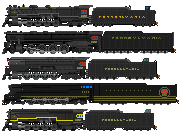
This is a complete list of the 4-8-4 steam locomotives the PRR built from 1932 to 1946. They were labelled the R series, and many were used in fast freight and passenger assignments. Among their crews, each subclass had a different nickname.
General History:
As the 1930s drew up, the Pennsylvania Railroad began to see the deficiencies its pre-existing motive power had become apparent. Train often had to be doubleheaded, or even triple headed. The S1 duplex was not able to go much on the PRR. So, the PRR got a new mechanical engineer, an Italian immigrant named Agusto Bianchi. Bianchi analyzed the issue, then, he made his big conclusion announced at the PRR headquarters in Philadelphia. He declared that it was not only time to begin operating bigger and stronger engines, but it was time of make them fast. Hence the development of the P series Hudsons (called Keystones by the PRR), U series Berkshires, R series Northerns, and even a proposed Texas type of their own design, as opposed to based off the C&O T1. Plus numerous articulateds similar to those of subsidiary Norfolk and Western.
Classes and their histories:
- The R2: The first 4-8-4 steam engines. These were built in the 1930s when the PRR wanted a larger engine than their I1 decapods to haul heavy trains on branchlines without any assistance whatsoever. The result was to simply extend the M1 4-8-2's trailing truck to allow for more weight distribution. Though more powerful then the I1s, they did not do exceptionally well on branchlines. But they did marvelously on the mainline, which justified their continued production. They were mainly referred to as "Rhinos", similar to how the I1s before were called "Hippos"
- The R3: While the R2 did well in mixed traffic, the PRR mainly assigned them to fast freights and branchlines like the M1s. The PRR wanted a faster engine for their passenger trains. So, their solution was to create a design from scratch. The end result was the strong R3 class. These engines could run up to 110 mph (with some rumors saying they went beyond 125 mph) from Philadelphia to Chicago via Ft. Wayne, IN with only one stop for fuel, typically at Pittsburgh. They were mainly nicknamed "Keystones" by the railroad.
- The R4: When the first T1 duplexes arrived in 1942, the PRR was annoyed by their frequent maintenance issues. As a backup plan, the PRR ordered 6 similarly designed 4-8-4s, which were numbered 6112- 6117. They were mainly seen on New York- St. Louis trains like "The Spirit of St. Louis". Which is how they received the nickname "Panhandles."
- The R5: After the C&O's T1 Texas type was tested, leading to the conception of the J1, the PRR decided to do similar tests with other C&O engines. These included a Kanawha 2-8-4, a Greenbrier 4-8-4, a Hudson, and one of the new Lima type 4-8-6s. In the end, the PRR decided to use the Kanawha and the Greenbrier to create a pair of new, strong engines. The U2 and the R5 were the results of these ideas. The R5 mainly became a mixed traffic engine, but was mostly used on short- length passenger and freight trains through all of the PRR. Though the were especially prominent on joint operations such as The Pocahontas (with PRR subsidiary Norfolk and Western), or The South Wind (with the Louisville and Nashville, and its parent company Atlantic Coast Line), with some R5s even going all the way down the Louisville & Nashville to Montgomery, AL. The R5 engines were mainly referred to simply as "Northerns" after the division point on the PRR.
Related content






Comments: 22

👍: 0 ⏩: 0
👍: 0 ⏩: 0

The engine I got the idea from was actually based on it.
👍: 0 ⏩: 1

I would've figured. Did you know that the S2 was meant to be a 4-8-4?
👍: 0 ⏩: 1
I was wondering if you have. If the Pennsylvania railroad had rebuilded their S2 into a conventional 2 cylinder engine instead of scrapping it, just like how the LMS had rebuilt their turbine 4-6-2 into a regular conventional 2 cylinder engine, this is how I think it would mostly likely look like.
👍: 0 ⏩: 0
There was an actual 4-8-4 electric with that wheel arrangement and letter. Look up R1.
👍: 0 ⏩: 1

Oh I got it, the Whyte numbering gives it the class number. Thanks
👍: 0 ⏩: 0

I always thought that had the PRR had any 4-8-4s, they would've called them "Keystones."
👍: 0 ⏩: 1
That's the name I gave to their 4-6-4s
👍: 0 ⏩: 0

These look so brilliant! It's a real pity the Pennsy never built any Northerns in reality.
👍: 0 ⏩: 1
Tell . He made the first 3. I made the 4th one and the history behind each one.
👍: 0 ⏩: 1

These guys look like some of their tenders are longer than themselves. I do love me some PRR.
👍: 0 ⏩: 1
It seems to be the case with the R5s...
👍: 0 ⏩: 1
I wonder why. Seems a tad strange. Then again, US steamers are pretty strong.
👍: 0 ⏩: 1

You should see some of the Pennsy M1's or even the I1's. The Doghouse tenders they had were at least the size of the actual locomotive. I'm also convinced that the T1's engine and tender units are roughly the same in length.
👍: 0 ⏩: 1
Did you say... PRR M1?
I made a character that looks like
one of those once upon a time.
👍: 0 ⏩: 1
Yep. Wanna know a bit about him?
👍: 0 ⏩: 0