HOME | DD
 randomdinos — WWD - Elliot Formation

#coelophysis #heterodontosaurus #melanorosaurus #massospondylus #megazostrodon #protosuchus #dracovenator #highlandgiant
Published: 2016-11-06 00:39:51 +0000 UTC; Views: 20451; Favourites: 166; Downloads: 48
Redirect to original
Description
Early Jurassic, South Africa. Yes, this is an entirely new episode - since the Chinle plateosaurid is nowhere as big as it was portrayed in WWD, I wanted something that can give a good transition to the Morrison giants, and I knew exactly what that was.I do not own the references used for any of the animals; they belong to Aardonyx's description (HG) and Scott Hartman (everything else).
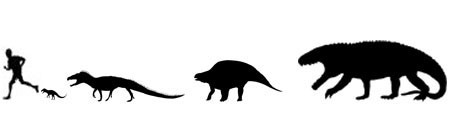
Right to left:
Protosuchus haughtoni: One of the oldest crocodyliforms, this meter-long predator with collumnar limbs spends most of its time on land chasing and eating whatever it can catch. Already a relatively good swimmer, it would also be portrayed occasionally diving after small aquatic prey.
Melanorosaurus readi: A sturdy early anchisaurian, this large herbivore represents the transition from small bipedal ''prosauropods'' to the later, quadrupedal ''true'' sauropods. The known specimen is a subadult, so the adult here is approcimatedly 8 meters long, large enough to be portrayed facing off against, and scaring off, a Dracovenator that times its ambush poorly.
Coelophysis rhodesiensis: Yay, Coelophysis again! An accidental link to the last episode, the sleek theropod now sees its role turned from small, but still somewhat dominant predator to scurrying between the legs of its titanic neighbors. It's a generalistic hunter just like C.bauri, but to differentiate it from its earlier cousin, C.rhodesiensis is usually solitary and does not form mobs to tackle large prey, sticking to bite-size food.
Anchisauria indet.: The very reason I chose the Elliot Formation to begin with. A group of these 16-meter behemoths appears briefly at the end of the episode, following the bloom of the vegetation, and in their passing casually scares away the Dracovenators (see the parallels to something here? *wink wink*). Also known as the Highland Giant.
Dracovenator regenti: This 6.1 meter long dilophosaurid rules over the region (when the Highland Giant isn't around, of course) and is the top predator of the ecosystem, hunting adult and juvenile sauropodomorphs and Coelophysis alike. The particular individuals that appear in this episode would be speculatively portrayed hunting in a disorganized, chaotic trio.
Massospondylus carinatus: A 5.8 meter bipedal prosauropod, it would be portrayed as a herbivore that may eat small animals on occasion to complement its diet. With those legs it's able to move relatively fast, but not as fast as its predators; thus, it relies mostly on numbers and a herd sentry system for defense, with the claws on its forelimbs being a last resort. One individual is surrounded and killed by the Dracovenators.
Megazostrodon rudnerae: Since the last episode did not have a cynodont (screw indeterminate taxa without available reconstructions...), this early mammal shows how much synapsids sucked through most of the Mesozoic. It behaves and feeds like a generic small mammal and is preyed upon by Protosuchus, Coelophysis and Heterodontosaurus.
Heterodontosaurus tucki: Representing the typical early ornithischian, the 1.7m heterodontosaurid would of couse be portrayed as an omnivore, eating both plants and small animals. Scurries about the undergrowth and one individual is taken down by a Coelophysis. Despite the lack of direct evidence, they would be shown to be somewhat able climbers, running up fallen logs or leaning trees to escape predators, because it's not unheard of for an animal without visible arboreal adaptations to be able to climb.
Related content






Comments: 77

👍: 1 ⏩: 0

what was your reference for protosuchus? I'm modelling the Elliot fauna in 3D, and i'm using your work for scale reference. but for modeling i prefer skeletal reconstructions. much obliged if you could send me some details.
PS: Just so you know, the highland giant seems to be closely related to antetronitrus, and was most probably an obligate quadruped. Iv'e spoken with one of the authors working on its description,so this is pretty much confirmed.
👍: 0 ⏩: 2

are you sure they didn't say that the Highland Giant was close to Antetronitrus in terms of ecology, not phylogenetically?
sorry if this is necroposting, just curious because McPhee et al. 2017 doesn't outright say that the Highland Giant is close to Antetronitrus phylogenetically, only grouping them together in the same ecomorphotype
👍: 0 ⏩: 1
In truth, I have not read the paper myself, so, it looks like you could be right on ecological similarity.
however, in conversation with one of the co-authors, i remember bein clearly told that they believed the Highland giant to be a possible sister taxon of antetronirus.
for now, it is still possible that either hypothesis is correct, but i would stay on the side of caution and depict The HG in a manner similar to antetronirus or melanorosaurus
👍: 1 ⏩: 1
ah, fair enough
which author would this be, by any chance?
👍: 0 ⏩: 1
i think, because i didn't get this person's permission to share this information, i'm not in a possition to divulge their identity. Not until the paper on the beastie is released, at least
👍: 0 ⏩: 1

I used a life reconstruction for it, but in the subject of skeletals there's these:
reptilis.net/wordpress/wp-cont…
laelaps.files.wordpress.com/20…
Awfully low resolution, but I guess not many people are interested in its anatomy (it could be a lot worse, too 
And oh, that's unfortunate, but makes sense.
👍: 0 ⏩: 1
On another note, do you have more detail on its relationship with Antetonitrus? Wedel and Yates (2011) puts it as an obligate biped based on the size and morphology of the ulna. I don't think size of the ulna is a good argument for stance, but still.
👍: 0 ⏩: 1
look at McPhee et al 2014: The complete anatomy and phylogenetic relationships of Antetonitrus ingenipes (Sauropodiformes, Dinosauria): implications for the origins of Sauropoda.
I haven't read it yet, but it looks like it will discuss locomotion. Mcphee and Choiniere are also co-authoring the Highland giant paper.
I found it at jonahchoiniere.weebly.com/publ…
👍: 0 ⏩: 0


BTW, if you plan on going directly from the Elliot to the Morrison, I suggest you do Kimmeridge instead of Oxford for the Jurassic sea episode. While the Morrison episode is probably gonna take place in the Kimmeridgian (or Tithonian), Oxford was at its highest diversity level in the Oxfordian, while Kimmeridge was surprisingly at its highest diversity level in the Tithonian.
👍: 0 ⏩: 2
Nah, I'll go with Oxford. I don't think it's so boring anymore. lel
👍: 0 ⏩: 1
So, Oxford after Elliot?
Also, make the episode take place 162 mya (a little before the Morrison episode should happen), and replace Cryptoclidus with Muraenosaurus.
👍: 0 ⏩: 1
Indeed.
Also, already done! I think.
👍: 0 ⏩: 1
OK!
Anyways, I hope that's true!

👍: 0 ⏩: 0

Whcih episode should I do first, Morrison or Kimmeridge?
👍: 0 ⏩: 1
The original had an AWKWARD transition from Mid-Triassic to late Jurassic. That's like having a series have one episode focused on the K-Pg boundary and then having the next episode set in the present day
👍: 0 ⏩: 1

Nice seeing the Highland Giant getting featured in an episode
Is it likely for Heterodontosaurus to be omnivorous?

👍: 0 ⏩: 1
Thanks!
Well, heterodont dentition is usually associated with omnivores, so it at least makes sense.
👍: 0 ⏩: 1


This would have been a great addition to Walking with Dinosaurs! I hate how it just skips right from the late Triassic to the late Jurassic in one episode.
👍: 0 ⏩: 1
Thanks! And yeah, the original had the weirdest time skips.
👍: 0 ⏩: 0

I think putting a transition(or transitions) between Chinle and Morrison is a great choice.
👍: 0 ⏩: 0

Heterodontosaurus actually had been found to have feet adaptations for tree-climbing, at least, if I'm not mistaken
👍: 0 ⏩: 2
That was Manidens afaik, but yes, they're close relatives so it's possible.
👍: 0 ⏩: 1

Not Heterodontosaurus, it was a different genus, though I'm not certain which one...but yes, it does have perching adaptations.
👍: 0 ⏩: 1
As randomdinos pointed out, 'twas Manidens
👍: 0 ⏩: 1

Also: lol at Dracovenator
It's interesting to see that the later coelophysids took on the role of top terrestrial predator. They basically pioneered the things megalosaurs, carnosaurs, megaraptorans, dromaeosaurs and tyrannosaurs.
👍: 0 ⏩: 1
Isn't Dracovenator a dilophosaurid, though?
👍: 0 ⏩: 1
The phylogeny there is messed-up
👍: 0 ⏩: 1
According to the latest phylogenetic analysis, only Dilophosaurus and Dracovenator belong to Dilophosauridae.
👍: 0 ⏩: 1
Dilophosaurids are probably coelophysoids though.
👍: 0 ⏩: 1
Yeah, coelophysOIDs.
They don't belong to the family Coelophysidae, though.
👍: 0 ⏩: 1
Oh, no, they're not coelophysids.
👍: 0 ⏩: 1
Glad we both acknowledge that.
👍: 0 ⏩: 0

Well holy hot damn is Megazostrodon smoooool.
Run, it's Massozilla!
👍: 0 ⏩: 1
Filthy filthy synapsids
👍: 0 ⏩: 0
| Next =>