HOME | DD
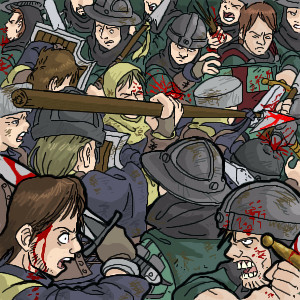
 Shabazik — Peasant Rabble

#battle #birthday #charge #folc #fyran #levy #militia #number #peasant #rebel #rebelion #rebels #rivier #seventeen #uprising #fyrd #huncle #disette #rivierie #hunclech
Published: 2016-11-01 02:36:41 +0000 UTC; Views: 14655; Favourites: 225; Downloads: 237
Redirect to original
Description
Mature Content
"Peasant Rabble" muttered one of the knights behind his helmet, as the horse moved under him, impatient for the charge that he knew was coming. "Look at them, charging like a howling horde...
not better than goblins, orcs and other savages, I tell you."
"You shouldn't dismiss them so quickly. Many of them had served in the Army of Huncle and against the Sargonic. You saw how they took care of that mercenary riders unit."
"precisely, mercenaries, not knights" the first knight said. "And they where only Peasant levies... nothing to be worried about."
"I heard, they have some bandit knights leading them, and that helped to form up their militia... and that they have some deals with the Kanovs and other savage tribes of the mountains, in exchange for weapons."
"And I heard, they are lead instead by a girl. We will ride over them without problem: as they see our charge, they will run like rabbits."
"The mercenary charge didn't went that well" the second knight pointed out.
Once more time, the first knight waved his hand "These are riding horses, not destrier heavy war horses"
"...And about them being lead by a girl, I remember in the Great War against the demons, the demons had plenty of women-warriors in their ranks"
"AH! And how that turned for them?! And we are speaking of a feeble farmer girl, not an amazon." the first knight said.
Then, they heard the order. The Hunclech knights prepared for the charge.
"This will be fun." the first knight said
"Fighting your own countrymen never is fun" the second answered, sighing.
"Oh, stop that. Rebel Rabble are outlaws, and not countrymen... and I would HARDLY call peasants our countrymen... I mean, can you even understand that horrible accent of them? it's other language, I tell you!!
So now, shut up and enjoy one of the national hobbies of the Hunclech nobility... to ride over peasants!!
FOR GOD, THE KING AND THE REALM!!
The Rivierie was a popular revolt in early Middle Human Age in North-western Aels by peasants that took place in eastern Huncle in the summer of 2.258 after the Aparition of the Human (a.a.H), after the First War of the Power (2.203-2.223 a.a.H).
The revolt, which was violently suppressed after two years of violence, was centered in the Ostergate valley, east of Huncle.
Why this rebellion became known as the Rivierie isn't clear: some say it was because the nobles derided peasants as "Rivier" as a generic name, or for their revolutionary leader referred to by the aristocratic chronicler Jacques Crossant as Disette Rivier .
The word Rivierie became synonymous with peasant uprisings in general in the Sargonic, Degolendish and Hunclech.
Background
After the capture of the fortess of Oster Gate by the King of Huncle and his warriors inspired by a Prophet, they didn't fullfiled his vission and where cursed by that Prophet.
Individually, this woulnd't have been causant for such a peasant rebellion, but after the First war of the Power the kingdom of Huncle was still in a weakened state, and being unnable the nobles and armies of the king to protect their peoples from the demons and the dark legion before had put their legitimacy in question:
And with the curse of the Prophet, even when he didn't represented the opinion of the official church, was seemed as a desligitimation of the king and the nobles to the peasants of Huncle.
Consequently the prestige of the Huncle nobility – which had begun the century at the defeats against the Dark Legion fleeing the field and leaving their infantry to be hacked to pieces, and had given up their king at La Cruz – had sunk to a new low. To secure their rights, the Huncle privileged classes, the nobility, the merchant elite, and the clergy, forced the peasantry to pay ever-increasing taxes and to repair their war-damaged properties under forgotten ancient taxes without compensation, aside of being conscripted the peasants to defend the castles of their lords.
The inmediate cause of the spontaneous uprising would be however when was decided to tax the rights to cut wood from the forests -legally property of the king-. With that tax being announced, the villagers decided that they had enough of that. Sedition spread like a forest fire inside the villages and soon the whole region was rioting.
The chronicle of Jacques Crossant articulates the perceived problems between the nobility and the peasants, yet some historians, Aq'ven Kaseem being one of them, see the Rivierie revolts as a reaction to a combination of short and long-term effects dating as early as the grain crisis and famine of 1995 and the Sargos-Huncle War of 1998 a.a.H. In addition, bands of grey elves, Kanov montangards, Sargonic and Degolandic routiers— unemployed mercenaries and bandits employed by the Huncle during outbreaks of the war against the orcs in the mountains range of Olga's Wall — were left uncontrolled, to loot, rape and plunder the lands of eastern Huncle almost at will, the King of Huncle powerless to stop them. Many peasants questioned why they should work for a government that clearly could not protect its citizens.
The uprising
This combination of problems set the stage for a brief series of bloody rebellions in eastern Huncle in 2.258 a.a.H. The uprisings began in a village of Bois de l'eau (Waterwood in Sargonic) near the Trèfle river, where a group of peasants met in a burned church under the command of a young widow who lost her wife during the assault to the orc fortifications in Ostergate.
There, they discussed their perception that the nobles had abandoned the people, and that the tax on the wood was unfair. "They shamed and despoiled the realm, and it would be a good thing to destroy them all."
The account of the rising by the contemporary chronicler Menteur de l'Eglise includes a description of horrifying violence. According to him, peasants
"killed a knight, put him on a spit, and roasted him with his wife and children looking on. After ten or twelve of them raped the lady, they wished to force feed them the roasted flesh of their father and husband and made them then die by a miserable death."
Examples of violence on this scale by the hands of Huncle peasants are offered throughout all of the western-Aelian sources, including Nombre Dix-Sept, in general sympathetic to the peasants' plight, and the particularly unsympathetic aristocrat Jean Pompeux.
The peasants involved in the rebellion seem to have lacked any real organization, instead rising up locally as an unstructured mass. It is speculated by Jean le Boiteux that evil governors and tax collectors spread the word of rebellion from village to village to inspire the peasants to rebel against the nobility. When asked as to the cause of their discontent they apparently replied that they were just doing what they had witnessed others doing. Additionally it seems that the rebellion contained some idea that it was possible to rid the world of nobles.
Pompeux's account portrays the rebels as mindless thugs bent on destruction, which they wreaked on over 150 noble houses and castles, murdering the families in horrendous ways.
Outbreaks occurred in all eastern Huncle, while some northern Degolendic cities were sacked by the peasant army. Meanwhile, The bourgeoisie of many cities of Western Huncle, sorely pressed by the court party, accepted the Rivierie, and the urban underclass were sympathetic. It is notable that churches were not the targets of peasant fury.
Suppression
At first, the armies of Huncle -still weakened since the end of the end of the First War of the Power- were wagging war at the south: As well, due the curse of the Prophet, many of his troops had deserted him upon supersition, so when he finally was able to march back to eastern Huncle, his army arrived in the advanced winter, and facing a large peasant army and lacking a foothold in his own country, he wasn't able to organize an efficient repression: and so, they did the Pacts of Christmas of 2.258.
After the weeks of violence, with this pact between the king, nobles and the peasants of the Valley of Oster Gate, it was instituted not only an amnesty to all the rebels and their leaders, but as well many of the taxes where outlawed and the feudal system of Huncle was renovated, claiming many that the Pacts of Christmas can be seen as the first constitution of western Aels -while others claims is instead the Gran Carta de Sargos-.
The Pacts of Christmas where a great victory to the rebels and an humilliation to the King of Huncle. While many of the rebel leaders as important political figures of the region, conforming a self government in eastern Huncle, the king retreated to his western possetions.
In the following year, during 2.559 the violence will continue, but in a sporadic way: riots and protests, divisions among the same peasants, and as well uprisings in near provinces, which worried not only now the king of Huncle and his nobles, but as well the neighboring kingdoms of Degoland, Sargos and La Cruz, specially after the death of the King of Huncle Charles IV due a hunting accident: the sucession was unclear, becoming Charles le Gros the Regent, and claiming the Throne prince Phillipe II Vautur and king of Sargos.
With rebelion once again expressiong in violent assaults to castles and noble mannors, the prince (and aspiring to the throne) Phillipe II Vautur, with his possition too weakened to solve the situation in his own, contacted in secret with the King of Sargos, Martin the Conqueror.
Sargos, in that moment rising as one of the more powerful human kingdoms of Northwestern Aels, seeing this as an oportunity not only to restore peace of the distirbed society (To their standards), but as well as an oportunity for territorial expansion.
They began with an offensive of the church, who claimed all these peasant uprisings as hereticals and sinful, while the Sargonic army slowly prepared for war.
In the 2.260, it was the end of the Commune of the Valley of Ostergate and their independent rule.
The revolt was suppressed by Huncle and Sargonic nobles led by Martin the Conqueror of Sargos, cousin, brother-in-law and mortal enemy of the Regent Charles le Gross, whose throne he was attempting to usurp.
When knowing of the Sargonic invasion of Eastern Huncle, the Commune and their leaders claimed Prince Phillipe II Vautur to be a traitor to Huncle and rallied their forces in a hurry:
Finally, Martin the Conqueror and the peasant army opposed each other near Dix-Sept on 10 June 2.260 a.a.H.
There, the large but untrained, unequiped and without discipline peasant army was ridden down by divisions of knights' cavalry in the ensuing Battle of Dix-Sept, which was followed by a campaign of terror throughout the Oster Gate region, where soldiers roamed door to door in the countryside lynching countless peasants and killing thousands and thousands in the fury that followed.
The nobles and the sargonic soldiers plundered the cities and churches and set fire to all eastern Huncle, which burned for two weeks, overrunning the countryside, burning cottages and barns and slaughtering all the peasants they could find.
The reprisals continued through July and August. There was a massacre after other as Martin The Conqueror and his Sargonic army slowly advanced now to western Huncle, where the regent Charles le Gross, who feared both the rebels and the Sargonic, didn't do nothing to stop the invasion of their southrn neighbors until the Rebelion was smashed...
Then, instead of fighting the invader, Charles le Gross gave the crown of Huncle to Phillipe II vautur, becoming Huncle an allied state of Sargos.
A declaration of Amnesty was issued then by Phillipe II as the Sargonic army returned to their own country -leaving an important garrison to ensure the "loyalty" of the now king Phillipe II-
The leader of the revolt, Disette Rivier, disapeared after the battle of Dix-Sept. Some say, she died on that battle. Others, that she was captured and interned as nun on a monastery... and others said, she left, to become a spirit of rebelion of Aiers.
Related content






Comments: 51

"Alright guys. I'm just going to relieve this dead knight of maile, sword and helmet and put it on! That way our rebellion will go that much better with an armored guy on our side!"
👍: 0 ⏩: 0

"The Peasants are revolting!" "What else is new?" "They're also attacking the nobility." "Oh."
👍: 0 ⏩: 3

👍: 0 ⏩: 1
👍: 0 ⏩: 0


👍: 0 ⏩: 0

Pretty much like Latvians, who get their potato taken awa-whoops, scratch that; when taken potato away, a REAL Latvian would only cry quietly, and carry on with his/her suffering, and melancholy. It is embarrassing as fudge, to know that the only more recent Latvian riot in 2009: www.youtube.com/watch?v=yKGL8O… was stopped by one of those oligarch richasses shaking his finger at the protesters and saying: "Mind you: you will have to pay for every broken window of Saeima House, and a new window costs like 10,000 lats (about 14200 EUR)", after which most of the protesters scattered.
Eh... My poor, poor potatoland with its poor, poor servant-mindset people... And a new slavemaster seems to have increased his presence over at the Eastern Latvian borders...
Such is life.
But great work, overall - I really love, how dynamic the peasants look in this drawing!

👍: 0 ⏩: 1

I gotta say, I like that young female who is leading this rabble-rousing army. She looks cute.
👍: 0 ⏩: 1

Aye, you destroy the peasantry and who will raise your crops and tend the herds? Nobles can be so stupid! Long live Disette!
👍: 0 ⏩: 3
👍: 0 ⏩: 1
👍: 0 ⏩: 1
👍: 0 ⏩: 1
👍: 0 ⏩: 0

They farm on the Nobles' lands, house their herds in their castles, and sell their warehouses for mules.
👍: 0 ⏩: 1
I'll go along with that!
👍: 0 ⏩: 0

Tsk. There are always peasants eager for lands!! The better would be to bring sargonic colonists, much more reliable than these Hunclech barbarians v___v
👍: 0 ⏩: 0

Charge!!!!!
Nice scene you have here shab. Nicely done!
👍: 0 ⏩: 1

A rebellion is no good if the fighters don't know how to fight, don't know where they need to do the fighting, nor have a semblance of organization. Anyone can pick up an axe and swing it. But not everyone can just pick up an axe and wield it. That's where training comes in.
👍: 0 ⏩: 2

That's the kicker ; men from the Folc Fyrd were not only actually drilled and trained to fight against demons since the second war of power, but also were put into use during the duchal wars within Huncle fronteer provinces. Many of them are actually ex soldiers and veterans, Fyran, the man with the eyepatch, became later on, far after the rebellions, an invincible fighter known to be a knight killer.
number-seventeen.deviantart.co…
👍: 0 ⏩: 0

A scene from the Battle of Dix-Sept? Nice to see such an active "Folc Fyrd" pic! The 'tailed cowl' guy is interesting!
👍: 0 ⏩: 1
For the text, I would say a previous battle between nobility of Öster Gate and the rebels!
👍: 0 ⏩: 0

Nice! An epic rebellion.
I always cheer for the peasants.

👍: 0 ⏩: 2
👍: 0 ⏩: 0


If you study successful revolutions you will see that they were successful because the soldiers joined the rebels. England, France, Russia. Or that there were NO soldiers. China. Otherwise...
👍: 0 ⏩: 2
True in the long run but it is normally the Rabble that win the key early battles, the problem is that at some point farmers need to farm and craftsmen need to craft or the economy will collapse, which is the point where real soldiers need to take over for the revolution to win.
👍: 0 ⏩: 0

looks great! old school like a village after an ogre
👍: 0 ⏩: 2
👍: 0 ⏩: 0
yes, but once I re-scan this on better quality and re-upload, I will need to resize the guy who's meant to be short of a giant, and here despise being the first one we see he's probably the smallest adult man in the whole Öster Gate
v___v
👍: 0 ⏩: 2
I'm thinking that Fyran is larger in spirit and 'presence' than he is in body.
👍: 0 ⏩: 0

Yeah aI was like "hes pretty tiny"
👍: 0 ⏩: 0