HOME | DD
 EmbassyOfTime — Smooth Lighting

#3d #game #light #planet #programming #space #star
Published: 2017-05-22 20:08:06 +0000 UTC; Views: 127; Favourites: 1; Downloads: 0
Redirect to original
Description
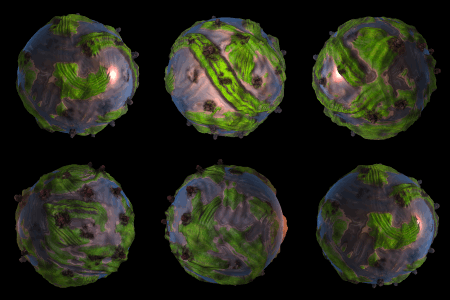
Smooth is the word.... (old movie reference, sound out if you know it!)After a mindbending search for an ooold bug that never manifested before now, I managed to get the new ligting system to work (presumably) right. That means bye-bye to harsh triangles and hello to smooth surface coloring. This happens to be a star; I was using purple as a test color, because normal colors are too complex to judge the results on. And yes, the star has a shadow side. Everything is still set to simply make the top of anything lighter than the bottom. Next in line: Making the light actually come from the star. Wish me luck!
Related content










Comments: 2

Just saying, if you keep this formula the same, it would be perfect for giant gas planets like Jupiter! In fact, I thought this would resemble a giant gas planet. Did you know that Jupiter has all it takes to be a star by itself, but that it just lacks the mass to really be one? When the planets formed, the sun took away most of the solar system's mass in a short time, thus preventing Jupiter to gain the mass to become a (smaller) star by itself, otherwise we would have had a binary solar system, which is actually way more common than a single star system.
Good luck getting that light formula right, I'm excited to see the result, especially if you happen to get solar spots and flares in!
👍: 0 ⏩: 1

Yes! To all of it, I think! Yes, I know about Jupiter being a too-small-to-be-a-star, and that the Sun hoards matter in the solar system (98.14% of it, I think), and that bonaries are actually very common. The most common stars are actually Red Dwarf stars (no puns about the TV series, though), and just smaller than those are Brown Dwarfs, which are almost big enough to become stars, but only manage to produce heat through gravitational compression and possibly some fusion of pure deuterium (hydrogen with an added neutron, a.k.a. "heavy hydrogen"). I did some blogging about it on my more purely technical blog: www.gamedev.net/blog/2367/entr…
Also, I thought the same when I first sat the smooth surface, that it looked like a gas giant. I got something going with a crater surface right now, but yeah, it's in my ToDo list now. I want to soon get as varied planets as possible out there. And maybe then also some binary systems, though that will be, uhm, a challenge!
👍: 0 ⏩: 0