HOME | DD
 Killgareth — Krog

#alienspecies #sciencefiction #sculptris
Published: 2017-06-01 16:59:23 +0000 UTC; Views: 1134; Favourites: 6; Downloads: 2
Redirect to original
Description
The Krog a species of stout, fierce predators from the high gravity world of Rasikazia, located close to the galactic core. Despite being young compared to other superpowers of the galaxy, the krog have risen to create a fairy large and powerful empire that has had significant impact on the galaxy.
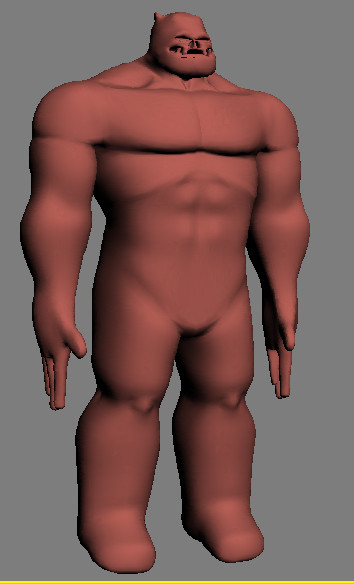
Their homeworld of Rasikazia is a small but dense world, with a surface gravity of 1.49 g and a fairy hot climate, and a result the krog have adapted to be hardy creatures; standing at an average of 1.5 meters, their body density is very high even for high gravity species, and even with their stout appearance they are heavier than they look, with a though, leathery skin that comes in various shades of brown, bronze and red. Their other notable feature is their large head adorned with a crown of horns, two large eyes with excellent night vision and a mouth filled with sharp teeth and harsh lips.
Being from a fairy desolate desert planet, the krog are most active during the night, hence their big eyes, and have retractable claws in their three fingers. As their high gravity world makes even dense bone structure vulnerable to breaking from simple falls, the krog aren't the fastest hunters, but are fast enough to outrun, if briefly, most of their natural pray and as they are pack animals are more than capable of defending from fiercer predators. Off world, in lower gravity, they can be extremely dangerous some of the fiercest fighters in the galaxy, although still fairy slow and quick to tire. As they are desert creatures, they have several ways to survive long periods without water or food, the foremost being a layer of blubber concentrated in the breast area that serves to store vital reserves as well as to insulate vital organs during cold nights.
In the deserts of Vas'Ald Kraiz, the krog evolved as pack animals hunting in groups of up to 20, lead by two or three large males and a small harem of three to five females, the rest being their offsprings and occasionally a temporary straggler or two ; up until they fully mature, both males and females are raised together by the group, but after reaching adulthood, the age at which varies from tribe to tribe, both are forced to, and indeed compelled by instinct, to leave and either join other tribes of form their own. As the krog practice polyamory, both males and females have little in the way of devotion to their mates, although more often than not they do have a primary mate that is mostly for the sake of strengthening their position in the tribe, with their children acting as subordinates. Particularly large tribes usually split in two or three, and usually the oldest offsprings of join their parents with own mates to co-rule. While not particularly loyal to spouses, krog society dose put a heavy emphasis on loyalty to one's tribe.
Another major aspect of krog society is hospitality to strangers, especially strangers that are not in rival tribes; most religions that have arisen from the krog are ancestral worshiping, and neglecting to be hospitable to strangers with no good reason is the greatest transgression one can make and a surfeit way to forfeit their afterlife. The krog tribes used to have fairy large territories and would rarely encounter each other frequently enough to war with each other, and the harsh desert could end one's life at any moment; thus the almost compulsive obsession the krog developed towards hospitality as another way to increase survival chances. That being said, when the krog tribes did began to come in contact with each other more often, especially after most tribes abandoned outright hunting for domestication, thus the need for suitable land to grow the animals, they rarely showed much mercy to rival tribes but would often times absorb survivors and if the enemy surrendered they would be spared and allowed to live on, but as second class citizens. Unsurprisingly, the city states weren't the particularly stable, rife with inter class strife and more often than not would collapse from withing, but many still managed to endure.
The imperialistic cities states would spread across Rasikazia and be the primary socio-political and cultural structure for millennia. However, the hospitality towards strangers remained, especially towards more distant cities and tribes. As is often the case, brutal wars and conflicts between the cities would accelerate technological progress; by apr 1500 BCE, the krog were at the equivalent of mid 19th century Earth, with primitive steam power engines, an ever expanding body of scientific progress and new, deadly weapons. What remained the same, however, was the rivalry and conflict over rare resources; as the cities grew, more and more food was needed, and as technology allowed for faster communication and travel, the range that cities would consider each other friendly increased until most city states on the planet considered each other enemies. Wars increased in regularity and brutality and the powder keg eventually came to a head in approximately 1300 BCE when the Hundred Year Darkness nearly brought about the species extinction.
Nothing that the more peace oriented civilians or official diplomats could do had any effect in stopping the nuclear conflagration; some 20% of the planet's population at the time was annihilated in a matter of days, and another 60% died off during the nuclear fallout which followed. The survivors were reduced to a few small enclaves built before the war erupted, the largest being the vast underground caverns of Thuundezar, which managed to preserve the species heritage for the future in general safety. The rest of the species struggled on the surface for basic necessities. However, much to the species fortune, just a hundred years after the nuclear war a passing alien ship, belonging to the Crocutan empire in a diplomatic mission to the garician worlds stopped to refuel close enough to the system to detect the nuclear detonations. A further investigation in apr 1200 BCE made first contact with the surviving krog civilization, and the Crocutan empire was quick to offer its assistance in rebuilding, mostly to gain an ally in a strategically important location, namely right in the middle of the quickest rout between it, and by proxy the Script Freehold, and the garician worlds, some of the Freehold's main allies.
Over the next few centuries, the krog slowly rebuilt their civilization with the new technology at their disposal and even managed to create a small stellar nation of their own. The krog set out to redefine their civilization so that such devastation could not happen again; the Krog Imperium was formed, lead from Thuundezar by a Senate, itself led by a Consul elected by the general population for life to rule over all krog and create a sense of belonging between all tribes and thus eliminate inter tribe rivalry. While successful in preserving peace, the Senate was struck by a different kind rivalry: political rivals seeking to gain enough prestige from each other and the civilian population to get elected as next Consul.
When the Groth War erupted in 800 BCE, the Imperium was neutral, much to the Crocutan's dismay, as it was occupied with its own problems due to previously coming in conflict with the other major power in the region, the ancient but weak empire of the Andun Nak. A cold war between them lasting from apr 800 BCE to 350 CE dominated most of the Imperium's external policies and lead to its enormous military build up which turned it from a third world newcomer into a first rate superpower despite its young age compared to the other superpowers. Due to being right on the main rout between several superpowers, the Impeirum also saw a large influx of traffic in its territory; the hospitable nature of the krog brought them prestige through the galaxy while their successful and decisive war against the more advance andun na in 400 CE brought them respect from the more martial oriented species such as the onsian and suuk.