HOME | DD
 Transapient — Dojo Overview

Published: 2011-04-27 20:35:29 +0000 UTC; Views: 7052; Favourites: 68; Downloads: 31
Redirect to original
Description
Dojos are a race of hexapoadal entities who have the unique disposition of having evolved on the surface of a moon of a pyloid, a planet without a star. When their mother planet, Fio (about three times Jupiter's size), was cast from its original solar system, it carried many of its moons with it. One of these moons, Sassu, would be the home of the dojo race. Sassu is a roughly earth-sized moon with a very thick atmosphere and higher surface gravity. Sassu is similar to Io in that it is subject to extreame volcanism due to Fio's gravitational influence. Several times in the early history of the moon, the surface was seemingly entirely melted, and as a result, remains radioactive to this day. Sassu probably would have suffered a similar fate to Venus of the Sol system, had Fio not become a pyloid. The volcanos, along with extensive radioactive decay, a thick insulating atmosphere, and a good amount of sodium in the crust, has kept Sassu warm enough to sustain a liquid ammonia thalassogen.Life is diverse on Sassu as on all other multicellular biosperes. Vast plains of thermosynthetic mat-like growths blanket the terrain in many meters. Long-lived radiosythesizers dot the landscape. Beasts of varying phylems roam the moon. Due to the extreame volcanism, the moon is dotted with archipelagos, subcontinents, islands, and various other small land structures. Plate tectonics are faster-paced, and continents collide and separate within thousands of years.
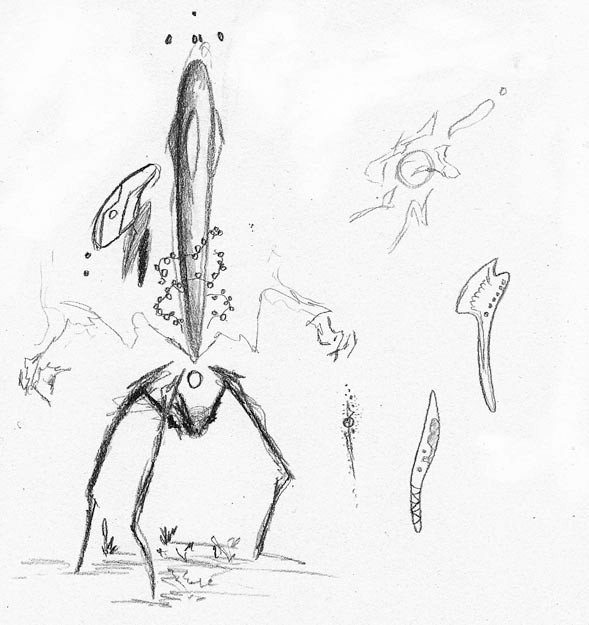
Dojos are well suited to their natural enviornment. They move with legs sprawed about the sides, as an upright creature would not fare well against constant tremors and earthquakes. The back-ends of their bodies contain vibration sensors to alert them to serious quakes and predators. Reproductive organs are folded within three hevily muscled skin flaps at the very tip of their behinds. They are also sensitive to certain chemicals associated with volcanic activity, such as carbon monoxide. The dojo body consists of two parallel/horizontal spinal cords which connect at three main pelvic gurdles. They have no 'top' or 'bottom' symmetry, and a dojo may flip over on his/her other side and continue their travels without hinderence. The three pairs of legs are acually rearrangable. Elastic, telescoping tendons allow the legs to slide along the spinal midsection. The legs cannot strech more than half their length away from their respective gurdles. Mouths are located at the ends of each of their appendages. Dojos evolved from the equivilent of insectivores, their 'foot-jaws' are narrow enough, and their 'lip-pads' are dextrous enough to fish-out amoebiforms in deep cracks and crevaces. Dojos pocess a shaft-like lung system which has nothing to do with respiration. They absorb gases directly from the atmospere through speciized patches of skin along their gurdles. The 'lungs' were originally a bouancy system for thier swimming ancestors. It is now thier prime method of communication. The lungs attatch and fill a myriad system of small air-pockets within each of the three body cavities. The 'lungs' slide to each of these and inflate each system with air, and these in turn will exchange, pulse, deflate, combine, and deform with the concious mind of the dojo. Sine one of their primary senses is sonar, they easily 'see' through to these air-sacks and so communicate with an intricate display of internal body language. The dojo's other main sense is vision. Dojos see through the radio proportion of the spectrum. The sources of this radio are the surface of their own moon, and Fio. They detect this with three telescoping eyes on their heads. The head itself can spin indepentently of the body with a ball-socket joint. All dojos are born female. They become males at about midlife. The lay purse-like eggs which hatch into dependent young. Young with hitch rides with their mother's by clinging to her choacal reigon with specialized 'baby-teeth' on their first pair of mouths.
Today, dojos have teraformed many pyloids in serveral galaxies. There are many subspecies and species, including the space-adapted overseers. The individual in the illustration is a baseline expectant mother, carrying her egg in a artificial pouch now raised on her terciary gurdle to reveil her genitals. She is currently vacationing in a space hotel with a large view of her home pyloid system. Her only clothing includes a watch and glasses. She dances in a zero-g room accompanied by a transapient yohi.
Related content




Comments: 13

I seem to find new stuff in you gallery when ever i look through it its strange any how i really like you aliens this guys awesome
👍: 0 ⏩: 0

Fantastic imagination^^I want posable toys of these creatures
👍: 0 ⏩: 1

HA! Wow, I'd like that too! Alas, if only we had plasmic shape-shifting blob-toys, but we are not that advanced.
-----
"Well excuse me for having enormous flaws that I don't work on!"--Homer Simpson
👍: 0 ⏩: 1
Ha ha. Dude you one uped me. I was just thinking normal plastic toys but plasmic shape shifting blob toys is the best thing ive ever heard. I totally want those!
👍: 0 ⏩: 0

Once again, your aliens "alien-y" nature = awesomeness!
Cute "space-fish"!
👍: 0 ⏩: 1
"Alien-y", XD!
Yes, its a yohi.
-----
"Well excuse me for having enormous flaws that I don't work on!"--Homer Simpson
👍: 0 ⏩: 1
Do you have already imagined how your space-adapted "Overseer" Dojos is going to look like? I´m asking because I got an interesting interpretation of those Dojo-versions and if you want, I can draw it.

👍: 0 ⏩: 1
Ah wow! I have an idea or two of what they basically look like, but I would love to see another artist's interpretation of it!
-----
"Well excuse me for having enormous flaws that I don't work on!"--Homer Simpson
👍: 0 ⏩: 0

ah, so they are rather like polypeds in the sense that they can reverse their orientation while walking....
this starless planet, is it a rouge to the point that it is constantly moving irregularily throughout the galaxy, or does it orbit around the general mass of many stars towads the central bulge?
I do find it difficult to think however, that arms as thin as that splayed out to the sides could support an organism in a high gravity enviornment... is their bone structure incredibly strong?
👍: 0 ⏩: 1
Fear not, your polypeds were not entirely the sorce of inspiration. I thought about them as I came up with the concept, but I was mainly inspired by the muuh, an alien race of Orion's Arm--[link] Plus, I figure such a design should be very useful on a world with such high volcanic activity, as a large earthquake may flip one over on one's back.
I pictured this pyloid orbiting a globular cluster of stars at a distance near the center of the galaxy (not our galaxy).
By splyed out, I mean they drag themselves along whichever spinal surface they are currently dragging on, like many reptiles on earth. Their bones are based on copper/hydrocarbons. I also imagined them sort-of 'suctioning' themselves along but surface tension with their tongues.
-----
"Well excuse me for having enormous flaws that I don't work on!"--Homer Simpson
👍: 0 ⏩: 0

Awesome design again - I especially love details like the glasses.
I'm curious about the word "pyloid" - did you invent it ? I've never heard of it before.
Also, her yohi friend seems to be quite cute by earthly standards !
👍: 0 ⏩: 1
Thanks. I can up with those things at the last moment.
"Pyloid", hmmm... Well, the word for me originated on some Nat Geo special. They were doing a thing about 'alien earths' as they called them. They mentioned the rouge planets, but I'm not quite sure what they called them now. I thought I heard a 'p' word which had something to do with 'oid', but then again I could be entirly mistaken. Tried looking for the word on google, but they just called them 'rouges' or 'orphan planets'. So I just started calling them pyloids and the name stuck to me, 'cause I like it. It also makes sense having a name like that instead of 'rouges' for something as common as pyloids. In a recent study I heard, during planetary formation around stars perhaps half of all newly formed planets get kicked out by competing gravitational forces of so many other planets, making pyloids amoung the most common hevenly bodies in the universe!
Yeah, I added him in as an example of other phlems on their planet.
-----
"Well excuse me for having enormous flaws that I don't work on!"--Homer Simpson
👍: 0 ⏩: 1
I see. Well maybe I'll use it too, it does have a nice ring to it.
👍: 0 ⏩: 0