HOME | DD
 deviantsock — Northern Secession

#alternatehistory #civilwar #confederate #csa #americancivilwar #confederacy
Published: 2016-07-31 19:20:06 +0000 UTC; Views: 5168; Favourites: 48; Downloads: 0
Redirect to original
Description

The point of divergence is the 1860 presidential election, in which John Bell, not Abraham Lincoln, is elected president of the United States. A member of the Constitution Union Party, their platform was "to recognize no political principle other than the Constitution of the country, the Union of the states, and the Enforcement of the Laws". They hoped that by failing to take a firm stand either for or against slavery or its expansion, the issue could be pushed aside.Bell's disdain of northern and southern calls for reform lead to both the North and South declaring secession from the Union. Eleven states formed the Southern Confederacy, while nine northern states comprised the Northern Confederacy. After the August 1861 capture of a British ship was mistaken for a South Confederate warship, tensions were at an all-time high. In reality the crisis was defused because the British were uncomfortable aiding a pro-slave nation. In this situation however the British felt comfortable aligning themselves to the Northern Confederates. The Treaty of Ottawa saw British recognition of the North as well as military and financial aid in exchange for the NCSA's abolition of slavery (which they were already poised to do) and to inhibit Southern Confederate expansion.
British and later French intervention were the saviors to the Federation. In desperation to hold on to its remaining territories the Union recognized and even allied themselves to the Southern Confederacy to defeat their common enemies. But it was of no use. The South surrendered in April 1864, followed by the Union two weeks later.
In the treaty of London the United States recognized the sovereignty of the Northern Confederacy and ceded the Ports of New Orleans and Atlanta to the victors. Following independence the NCSA was renamed simply to the "Atlantic Federation," separating itself from its former American statehood as much as possible. Their flag is a redesign of north confederate battalion flags, a recoloring of the Southern Confederate Flag, but with nine stars instead of eleven.
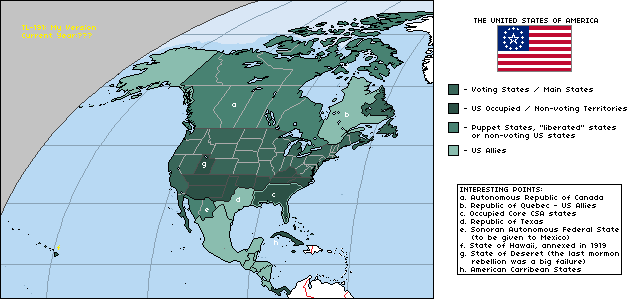
With the United States on the verge of collapse the American government shifted to more radical policies. The National Reconstruction Act saw all states and territories censored of anti-american redderick. The Mormon Uprising in 1881 and the Southern Mutiny of 1893 highlighted the extremes in which the federal government would act to maintain order. The north would remain a hallmark for democracy, ironically more free and representative than the United States itself.
Related content





Comments: 8

No mention of Michigan, Wisconsin, and Minnesota? Something tells me that they would be eager to jump on the secession train if the entire Eastern Seaboard wanted out.
...unless Ohio staunchly refused to join with them. Control of the port of Cleveland would effectively cut off the Western Great Lakes from the eastern seaboard, leaving the Rust Belt isolated...
It's definitely an intriguing possibility.
👍: 1 ⏩: 0

I would prefer a Federation of New England, excluding Pennsylvania, New York and New Jersey.
👍: 0 ⏩: 1

Similar to the real-world confederacy some slave states seceded and others didn't. Likewise the majority of those living out west were republicans, who valued American unity. The Midwest was less enveloped in the slavery debate, and would never secede from the union.
The midatlantic would have been desired by both parties, since the industrial cities of New York and Philadelphia are located there. New England does not have enough resources or population to sustain a nation rivaling the United States, so they'll need to expand south.
You could argue that in this scenario that New York, New Jersey and Pennsylvania ARE states of New England, culturally and politically bonded with the north. Similar to reconstruction the midatlantic states could be converted into New Englanders. Believe it or not Vermont was once part of French America, not New England, but was annexed into the U.S and made the fourteenth state.
👍: 0 ⏩: 0

What happened to nys that Lake Ontario flooded huge parts of the state
👍: 0 ⏩: 0

Never heard about that. Thank you for sharing.
👍: 0 ⏩: 1
